

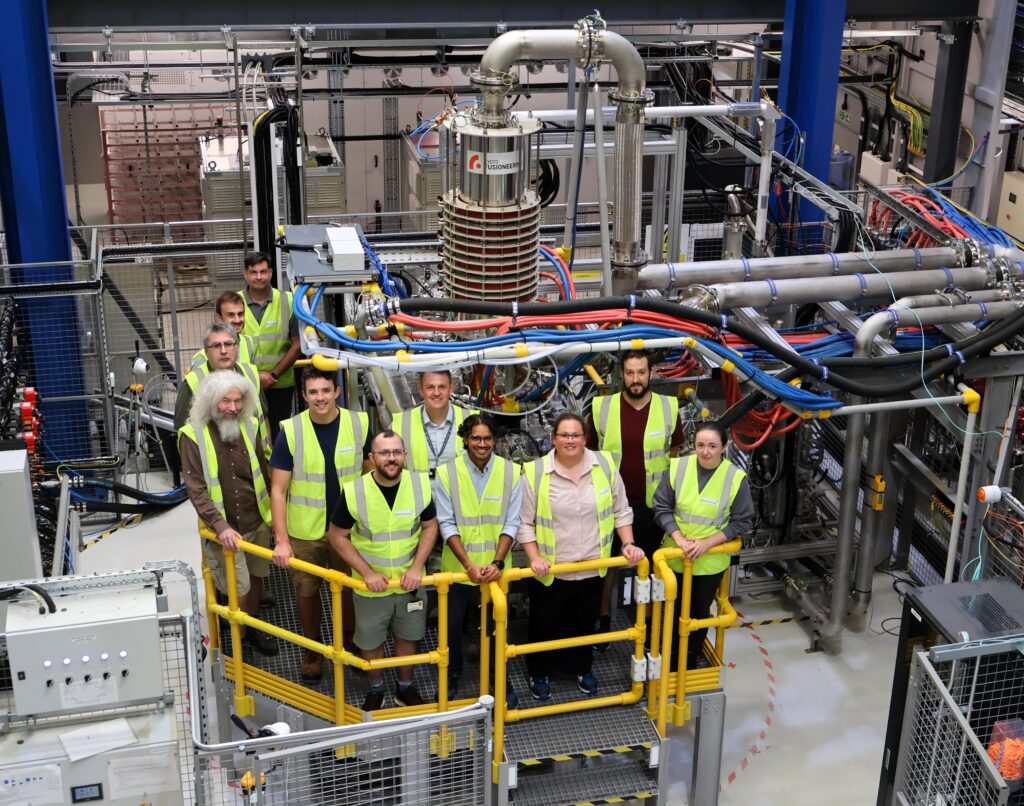
Tokamak Energy is set to install new fusion power plant fuel-heating technology on its high field spherical tokamak ST40.
The gyrotron team has successfully completed site acceptance testing to verify the radio frequency (RF) heating system’s performance ahead of installation on its record-breaking spherical tokamak.
The new gyrotron will generate high-power electromagnetic waves for controlling and heating a hydrogen plasma many times hotter than the centre of the sun. It will also be used to start up and drive plasma current.
During testing, the gyrotron demonstrated reliable 1 MW operation at both 104 GHz and 137 GHz, with pulse lengths of up to two seconds. Built by Kyoto Fusioneering for Tokamak Energy over 18 months, it also passed tests for repeatability, modulation, power control and mode purity, confirming it can consistently deliver the performance required for fusion experiments.
Through this project, the company is building valuable expertise in the integration and operation of high-power RF systems – a key technology for the next generation of fusion devices.
The focus now shifts to preparing the launcher, mirror polariser, transmission line and control systems ahead of installation and commissioning on ST40.
Once operational, the gyrotron will provide additional heating and current drive to ST40, supporting higher plasma performance and an experimental campaign exploring plasma heating, current drive, startup and ramp-up scenarios.
The project forms part of the company’s work with UK Fusion Energy (UKFE), helping build knowledge and capability for the UK’s STEP programme – a spherical tokamak design.
It will also play a key role in LEAPS, the company’s ST40 upgrade programme focussed on lithium systems supported by the US Department of Energy and the UK Department for Energy Security and Net Zero.
How does a gyrotron work?
A beam of electrons travels through a strong magnetic field which accelerates them to the point where they emit microwave radiation. This is directed through a waveguide to the plasma of fusion fuels – isotopes of hydrogen.
The frequency of the microwaves is tuned to match the cyclotron resonance frequency of the electrons in the plasma (104GHz or 137GHz in the case of ST40). When the microwaves interact with the plasma, they transfer energy to the electrons, which heats and drives the plasma.
A gyrotron, which uses Electron Cyclotron Resonance Heating (ECRH), solves one of the key challenges for a spherical tokamak – limited space for a central solenoid, which would otherwise be required to induce the plasma current. A gyrotron means the central solenoid can be reduced in size.
A big advantage over neutral beam heating is that gyrotrons can be positioned away from the device itself, whereas neutral beam heating needs to be very close.
On ST40, Tokamak Energy plans to use both its current neutral beam heating and gyrotron heating simultaneously. This will build greater understanding of how a gyrotron works, the control systems needed and the best balance between the two forms of heating.